
Board Performance · 2025
In this section15 topics
- Compliance Monitoring — Overview1 item
- Prevention of Conflicts of Interest3 items
- Prevention of the Use of Inside Information3 items
- Anti-Corruption4 items
- Whistleblowing3 items
- Selection of Directors & Chief Executives4 items
- Selection of Independent Directors2 items
- Director Development2 items
- Evaluation of Board & Subcommittee Performance2 items
- Subcommittees1 item
- Meeting Attendance & Remuneration3 items
- Supervision of Subsidiaries & Associated Companies5 items
- Board Duty Performance — Overview1 item
- Audit Committee Duty Performance1 item
- Executive Committee Duty Performance1 item
Compliance Monitoring — Overview
Monitoring of Compliance with Other CG Policies & Guidelines
Over the past year, the Company has continuously monitored and evaluated compliance with good corporate governance policies and practices in various aspects, covering the Board of Directors, sub-committees, executives, and employees at all levels, to ensure that business operations are transparent, ethical, and in line with good corporate governance principles, as well as relevant laws, regulations, and regulatory requirements.
The Company has stipulated that key policies be reviewed regularly, at least once a year, such as the Good Corporate Governance Policy, Business Ethics Policy, Anti-Corruption Policy, Conflict of Interest Prevention Policy, Insider Trading Policy, Whistleblowing Policy, and Sustainability Policy, to ensure they are appropriate, up-to-date, and consistent with the Company's business direction and evolving regulations.
In addition, the Company has communicated its policies and practices to directors, executives, and employees through various channels, including training sessions, dissemination through the internal information system, and requiring acknowledgment and adherence through signatures, to foster concrete understanding and implementation.
Based on the monitoring and evaluation conducted over the past year, no material violations of policies or practices related to good corporate governance were identified. The Company has been able to operate in compliance with its policies, good corporate governance principles, and the relevant regulatory requirements appropriately. Directors, executives, and employees have completed the training at a rate of 100%.
Prevention of Conflicts of Interest
Has the Company Acted to Prevent Conflicts of Interest?
Yes
Operations in the Past Year
The company prioritizes conducting business with transparency, fairness, and considering the best interests of the company and all stakeholders. It has clearly established policies and guidelines for preventing conflicts of interest, covering the Board of Directors, sub-committees, executives, and employees at all levels, to prevent personal gain from official positions or any actions that could conflict with the company's interests.
The company requires directors, executives, and relevant parties to fully, accurately, and timely report their interests and any potentially related transactions to the company. This includes abstaining from voting and not participating in the approval process for matters in which they have an interest. For related party transactions or transactions that may create conflicts of interest, the company will proceed according to the criteria of the Securities and Exchange Commission and the Stock Exchange of Thailand, with due consideration for reasonableness, commercial terms as if transacting with external parties (Arm’s Length Basis), and transparent disclosure of information.
Furthermore, the company continuously communicates policies, provides training, and educates directors, executives, and employees to enhance awareness regarding the prevention of conflicts of interest. Additionally, it has established whistleblowing channels and measures to protect complainants.
In the past year, the company has not found any cases of conflicts of interest or related party transactions that created conflicts of interest. The company has strictly adhered to the established policies and criteria.
Number of Conflict-of-Interest Cases
| Metric | Current Year | Previous Year | Two Years Ago |
|---|---|---|---|
| Total number of cases or issues related to conflicts of interest (cases) | 0 | 0 | 0 |
Prevention of the Use of Inside Information
Has the Company Acted to Prevent the Use of Inside Information?
Yes
Operations in the Past Year
The Company places great importance on preventing the misuse of insider information for undue personal gain, which could lead to unfairness towards shareholders and general investors. Therefore, the Company has clearly established policies and guidelines for the safeguarding and control of insider information, covering the Board of Directors, sub-committees, executives, and relevant employees.
The Company mandates that individuals with access to inside information, which is material information that could affect securities prices and has not yet been disclosed to the public, must strictly maintain the confidentiality of such information. They are prohibited from buying, selling, transferring, or receiving transfers of the Company's securities, whether directly or indirectly. This also includes prohibiting the disclosure of such information to others or recommending that others trade securities based on inside information.
Furthermore, the Company has established a securities trading blackout period for directors, executives, and related persons prior to the disclosure of financial statements or other material information of the Company. It also requires the reporting of securities holdings and changes in securities holdings by directors and executives in accordance with the criteria prescribed by the Securities and Exchange Commission.
The Company regularly communicates policies, provides knowledge, and raises awareness among directors, executives, and employees. Furthermore, it has supervisory and monitoring measures, as well as disciplinary penalties for violations of these policies, to ensure strict compliance.
In the past year, the Company has not found any instances of insider information being used for personal gain or any actions that constitute a violation of the aforementioned policies. The Company has strictly adhered to and complied with the established criteria.
Number of Inside-Information Cases
| Metric | Current Year | Previous Year | Two Years Ago |
|---|---|---|---|
| Total number of cases or issues related to the use of inside information to seek benefits (cases) | 0 | 0 | 0 |
Anti-Corruption
Has the Company Acted on Anti-Corruption?
Yes
Operations in the Past Year
Anti-Corruption Policy and Implementation
The Board of Directors shall oversee the establishment of clear anti-corruption policies and practices and ensure that such policies are communicated at all levels of the organization as well as to external parties in order to ensure effective implementation. The Company also promotes initiatives and guidelines to prevent fraud and corruption, including supporting activities that encourage and instill awareness among all employees to comply with applicable laws, rules, and regulations.
The Board of Directors supervises the development of an anti-corruption policy aimed at preventing and controlling risks arising from corruption and fraud, as well as mitigating potential impacts on the Company’s reputation and credibility in conducting business with integrity. This policy is applied to the Company’s human resource management, beginning from the recruitment and selection processes. Candidates selected for employment must not have a history of disciplinary misconduct or convictions related to corruption or fraudulent activities.
Furthermore, in matters of promotion, performance evaluation, and remuneration, the Company considers employees’ performance in alignment with the anti-corruption policy and ensures that employees have no record of involvement in corruption or behavior that may hinder compliance with this policy.
The Company also communicates the policy and raises awareness to ensure proper understanding of anti-corruption measures. This includes orientation programs for new employees, training programs, and knowledge assessments related to the policy. In addition, the Company discloses relevant information regarding the policy to the public and stakeholders through both internal and external communication channels to ensure transparency and awareness.
Form of Anti-Corruption Operations
| Operation |
|---|
| Review of appropriateness in anti-corruption |
| Communication and training for employees on anti-corruption policy and guidelines |
| The monitoring of the evaluation of compliance with the anti- corruption policy |
| Review of the completeness and adequacy of the process by the Audit Committee or auditor |
Number of Corruption Cases
| Metric | Current Year | Previous Year | Two Years Ago |
|---|---|---|---|
| Total number of cases or issues related to corruption (cases) | 0 | 0 | 0 |
Whistleblowing
Has the Company Implemented Whistleblowing Procedures?
Yes
Operations in the Past Year
The Board of Directors oversees the mechanisms and processes for managing (recording, tracking progress, resolving issues, reporting) stakeholder complaints, including channels for reporting corruption complaints. These complaint channels are disclosed on the website or in the annual report (Form 56-1 One Report), and suggestions regarding anti-corruption measures are openly accepted from partners and stakeholders.
The Board of Directors will ensure clear policies and guidelines are in place for whistleblowing. This includes establishing channels for reporting through the company's website, or via the Chairman of the Board, or the Chairman of the Audit Committee, as well as processes for verifying information, taking action, and reporting to the Board of Directors.
The Board of Directors oversees the systematic management of complaints to protect the rights of complainants and whistleblowers acting in good faith. Information shall not be disclosed to unrelated parties, except when disclosure is legally mandated by a court order or relevant regulatory authority.
The company has established processes, methods, and channels for reporting misconduct or unethical behavior that has been observed or learned, indicating that stakeholders have been affected or are at risk of being affected, which could cause damage to all stakeholder groups from the company's business operations or from the actions of directors, executives, employees, or staff of the company regarding violations of laws or business ethics and conduct, including behaviors that may indicate fraud, corruption, unequal treatment, or actions lacking caution and prudence. Whistleblowers or complainants can report misconduct with the following details:
Scope of Whistleblowing or Complaints
Covers reporting information or behaviors that may constitute a violation or non-compliance with the company's policies, regulations, rules, and relevant laws, as well as cases of unfair treatment in operations, or actions of personnel related to soliciting or offering bribes, fraud, and corruption, which may cause damage to the company. However, the company reserves the right not to consider the following issues:
1.1 Matters related to the job application process
1.2 Opinion surveys or requests for general company information
1.3 Contact for requesting sponsorship or donations
1.4 Matters beyond the company's authority or scope of action
1.5 Matters that do not benefit the overall operations of the company
Channels for Complaints and Whistleblowing
Company personnel, including all stakeholder groups, can submit complaints or whistleblowing reports. They should specify the factual details of the matter they wish to report, along with their name, address, and telephone number for contact. The complainant's information will be kept confidential and they will not be affected in any way by providing such information. Reports can be submitted through the channels designated by the company as follows:
By postal mail addressed to "Chairman of the Audit Committee"
Onsen Retreat & Spa Group Public Company Limited
No. 120/5 Soi Sukhumvit 26 , Khlong Tan Subdistrict
Khlong Toei District, Bangkok 10110
Via email, sent to Company Secretary Office : comsec@onsengroup.co.th
Operational Procedures and Fact-Finding Process
Complaint Registration: The Chairman of the Audit Committee shall receive complaints and consider assigning the Head of Internal Audit or a person assigned by the Chairman of the Audit Committee to further investigate.
Verification and Data Collection: The Head of Internal Audit or a person assigned by the Chairman of the Audit Committee shall consider or assign the supervisor or head of the department of the accused to verify the accuracy and sufficiency of the information, including various facts, to screen the information received from whistleblowers or complainants, in cases where the investigation finds merit.
Investigation: The Head of Internal Audit or a person assigned by the Chairman of the Audit Committee shall submit documents to the Audit Committee regarding the investigation guidelines, including the necessity of establishing a special investigation committee to conduct the investigation in accordance with the company's regulations. If the investigation reveals information or evidence that reasonably suggests the accused has committed fraud, corruption, violated laws, regulations, rules, or the company's code of conduct, the company will grant the accused the right to be informed of the allegations and to prove their innocence by seeking additional information or evidence to demonstrate their non-involvement in the alleged wrongdoing. If the accused has indeed committed fraud, corruption, violated laws, regulations, rules, or the company's code of conduct, the perpetrator, whether a director, executive, employee, or company staff, shall be deemed to have violated the anti-corruption policy, good corporate governance policy, and the company's business ethics handbook, and shall be subject to disciplinary action in accordance with the company's established regulations. Furthermore, if the act constitutes a violation of law, the perpetrator shall be subject to both legal penalties and disciplinary action in accordance with the company's regulations.
Reporting to the Audit Committee: The Head of Internal Audit or a person assigned by the Chairman of the Audit Committee shall present the summary of the reported or complained matter and the results of the actions taken to the Audit Committee for acknowledgment.
Notification of Results to Whistleblower: Upon completion of the investigation process, the Head of Internal Audit or a person assigned by the Chairman of the Audit Committee shall inform the whistleblower of the summary of results and securely store all related files confidentially.
Principles of Operation
All steps of the process must be kept confidential, known only to assigned and involved individuals. The name of the whistleblower or complainant must not be disclosed under any circumstances, and this must be strictly adhered to.
Whistleblower Protection Mechanism
To protect the rights of complainants and information providers acting in good faith, the company will conceal the name, address, or any information that could identify the complainant or information provider, and will keep the complainant's and information provider's data confidential as whistleblower information. Access to such database systems will be restricted solely to the Internal Audit Department and the Audit Committee.
In cases of complaints regarding fraud or corruption by directors or executives, the Audit Committee will protect whistleblowers, complainants, witnesses, and individuals providing information in fact-finding investigations from suffering distress, harm, or injustice arising from whistleblowing, complaining, testifying, or providing any information.
The company will not take any unfair action against whistleblowers or complainants, whether by changing positions, job characteristics, workplaces, suspending work, threatening, interfering with work, terminating employment, or any other action that constitutes unfair treatment towards whistleblowers, complainants, or those cooperating in fact-finding investigations.
Those responsible for complaints must keep the complainant's information, complaints, and evidence, as well as the information provider's details, confidential. Disclosure of information to unrelated parties is prohibited, except as required by law.
In the year 2025, there were no reported cases of complaints related to fraud or corruption within the company. Furthermore, no violations of business ethics or actions contrary to ethical principles were found, nor were there any negative reputational issues for the company stemming from the Board's management.
Furthermore, there have been no instances of non-executive directors resigning due to deficiencies in the company's corporate governance or business operations.
Number of Whistleblowing Cases
| Metric | Current Year | Previous Year | Two Years Ago |
|---|---|---|---|
| Total number of cases or issues received through whistleblowing channels (cases) | 0 | 0 | 0 |
Selection of Directors & Chief Executives
Are Directors Selected Through the Nomination Committee?
No
Are Chief Executives Selected Through the Nomination Committee?
No
Rights of Minority Shareholders on Director Appointment
Criteria for Shareholders to Propose Agenda Items for the Annual General Meeting of Shareholders and to Nominate Persons for Election as Directors
Objective
Onsen Retreat and Spa Group Public Company Limited (“the Company”) recognizes the importance of shareholders and aims to treat all shareholders equally and fairly. The Company therefore allows shareholders to propose agenda items for inclusion in the Annual General Meeting of Shareholders and to nominate qualified persons for consideration as directors of the Company in advance of the Annual General Meeting, under clearly defined and transparent criteria and conditions established by the Company.
Qualifications of Shareholders Eligible to Propose Agenda Items and/or Nominate Candidates
Shareholders who wish to propose agenda items for the Annual General Meeting of Shareholders and/or nominate candidates for election as directors must possess the following qualifications:
They must hold shares with voting rights in aggregate of not less than 5 percent of the total voting rights of the Company as of the date of proposing the agenda item and/or nominating a candidate for election as a director. Such shares may be held by one shareholder or several shareholders collectively.
They must have held the shares specified in item 1 continuously for not less than one year and must continue to hold such shares from the date of submission until the date of the Annual General Meeting of Shareholders.
Criteria for Proposing Agenda Items for the Annual General Meeting of Shareholders
Shareholders who meet the above qualifications may propose agenda items for the Annual General Meeting of Shareholders under the following procedures and conditions:
A written proposal must be submitted to the Board of Directors by completing the “Request Form for Proposing Agenda Items for the Annual General Meeting of Shareholders” (which can be downloaded from the Company’s website), together with a summary of the proposal and supporting documents.
In the case where multiple shareholders jointly submit a proposal, each shareholder must provide their details and sign the form.
The proposed agenda must clearly specify whether it is for acknowledgement or for approval.
If the Board of Directors approves the proposed agenda item, the item will be included in the agenda of the Annual General Meeting of Shareholders and will be identified as an agenda proposed by shareholders.
If the Board of Directors does not approve the proposal, the Company will provide the reasons for not including the item in the meeting agenda in the notice of the shareholders’ meeting, and the reasons will also be explained again at the shareholders’ meeting.
Criteria for Excluding Agenda Items from the Meeting Agenda
The Board of Directors will consider the appropriateness of the proposed agenda items. The following matters will generally not be included as agenda items, unless the Board of Directors determines otherwise, and the Board’s decision shall be final:
Matters that violate laws, regulations, rules, or orders of government authorities or regulatory agencies, or are inconsistent with the Company’s objectives, Articles of Association, shareholders’ resolutions, principles of good corporate governance, or the Company’s Code of Business Conduct.
Matters relating to the Company’s normal business operations where shareholders have not demonstrated reasonable grounds for suspicion of irregularity.
Matters beyond the Company’s authority to implement.
Matters that primarily benefit specific individuals or groups and do not benefit the Company.
Matters that the Company has already implemented or has begun implementing.
Matters previously proposed to the shareholders’ meeting within the past 12 months, which received less than 10 percent of the total voting rights, provided that the facts of the matter have not significantly changed.
Matters where shareholders provide incomplete or inaccurate information, cannot be contacted, or provide unclear supporting documents or misleading information.
Matters that fall within the management authority of the Board of Directors, unless such matters could cause significant damage to the Company and/or shareholders as a whole.
Matters that the Board of Directors considers not beneficial to the Company’s operations or unnecessary to include in the meeting agenda, with reasonable explanation provided to shareholders.
Proposals submitted by shareholders who do not meet the specified qualifications or fail to comply with the Company’s criteria.
Criteria for Nominating Candidates for Election as Directors
Shareholders who meet the qualifications specified above may nominate individuals for consideration as directors under the following procedures:
Complete the “Nomination Form for Candidates for Election as Directors at the Annual General Meeting of Shareholders” (available for download from the Company’s website).
If multiple shareholders jointly nominate a candidate, each shareholder must provide their details and sign the form.
The nominated candidate must complete the “Consent Form for Nomination and Certification of Director Qualifications”, sign the document to confirm consent to the nomination, certify that all information provided is accurate and complete, and consent to the Company disclosing such information.
The Board of Directors will review the qualifications of the nominated candidates using the same criteria applied to other candidates before submitting the nomination to the shareholders’ meeting for consideration.
Individuals nominated for election as directors must possess appropriate qualifications and experience beneficial to the Company’s business operations and must meet the qualifications required under the Public Limited Companies Act, the Securities and Exchange Act, and other relevant laws, including notifications issued by the Securities and Exchange Commission (SEC), the Capital Market Supervisory Board, the Stock Exchange of Thailand, and other applicable regulations.
Candidates approved by the Board of Directors will be included in the agenda for the election of directors. If the Board does not approve a nomination, the Company will notify the proposing shareholders after the Board meeting, disclose the information on the Company’s website, and inform shareholders again at the Annual General Meeting.
Supporting Documents for Nomination of Candidates for Director Election
Shareholders must provide the following documents and certify copies with their signatures (or by authorized signatories in the case of juristic persons):
1.1 Proof of shareholding, such as a certificate of shareholding issued by a securities company, or other evidence issued by the Stock Exchange of Thailand or Thailand Securities Depository Co., Ltd.
1.2 Identification documents of shareholders
Individual shareholders: Copy of identification card, government officer ID, driver’s license, passport, or alien identification card (not expired).
Juristic persons: Copy of the juristic person registration certificate issued within the past three months, together with copies of identification documents of the authorized signatories. For foreign juristic persons, the documents must be certified by a Notary Public.
The nominated candidate must provide supporting documents for qualification consideration, including a consent letter for nomination as a director, personal profile, educational background, work experience, and other relevant documents beneficial for consideration.
Finally, Onsen Retreat and Spa Group Public Company Limited (“the Company”) has opened the opportunity for shareholders to propose agenda items and nominate qualified individuals for consideration as directors for the 2026 Annual General Meeting of Shareholders in advance, from 19 November 2025 to 31 January 2026.
Method of Director Appointment
| Method |
|---|
| Method whereby each director requires approval votes more than half of the votes of attending shareholders with voting rights |
Selection of Independent Directors
Criteria for Selecting Independent Directors
Consider and nominate candidates for the Board of Directors, sub-committees, and senior management of the company who possess the knowledge, abilities, skills, experience, and necessary attributes to drive the organization towards achieving its vision, mission, and strategic goals, taking into account skill diversity (Board Skill Matrix), independence, integrity, ethics, and good corporate governance, for submission to the shareholders' meeting or the Board of Directors' meeting for approval, as the case may be.
The qualifications and nomination process shall be defined as follows:
Qualification Criteria (Qualification Criteria)
Possess full qualifications and not have prohibited characteristics under the Public Company Limited Act, Securities and Exchange Act, and relevant regulatory requirements.
Possess knowledge, expertise, and experience consistent with the company's business strategy, industry, and growth direction.
Possess leadership, strategic vision, decision-making ability, and organizational oversight.
Possess integrity, business ethics, and the ability to dedicate sufficient time to duties.
For independent directors, they must possess independence qualifications as stipulated by the company and regulatory requirements.
Consider diversity in terms of skills, experience, gender, age, and expertise to enhance the overall effectiveness of the Board.
Nomination Process (Nomination Process)
The Nomination and Remuneration Committee (or a designated committee) is responsible for reviewing and considering the structure, size, and composition of the Board of Directors and senior executives to ensure alignment with the Company’s strategic direction.
Preparing and reviewing the Board Skill Matrix to identify the required competencies and any gaps in expertise.
Sourcing potential candidates from various channels, such as director databases, professional networks, the Thai Institute of Directors (IOD), or qualified experts within the relevant industries.
Conducting the screening and selection process, including verification of qualifications, professional background, potential conflicts of interest, and suitability in terms of corporate governance principles.
Proposing the shortlisted candidates to the Board of Directors for consideration and approval, and/or submitting the nominations to the Shareholders’ Meeting for appointment, as applicable.
Disclosing the nomination process, selection criteria, and profiles of nominated candidates transparently in the supporting documents for the Shareholders’ Meeting.
Did Any Independent Director Have a Business or Professional Relationship?
No
Director Development
Qualifications for Director Selection — Introduction
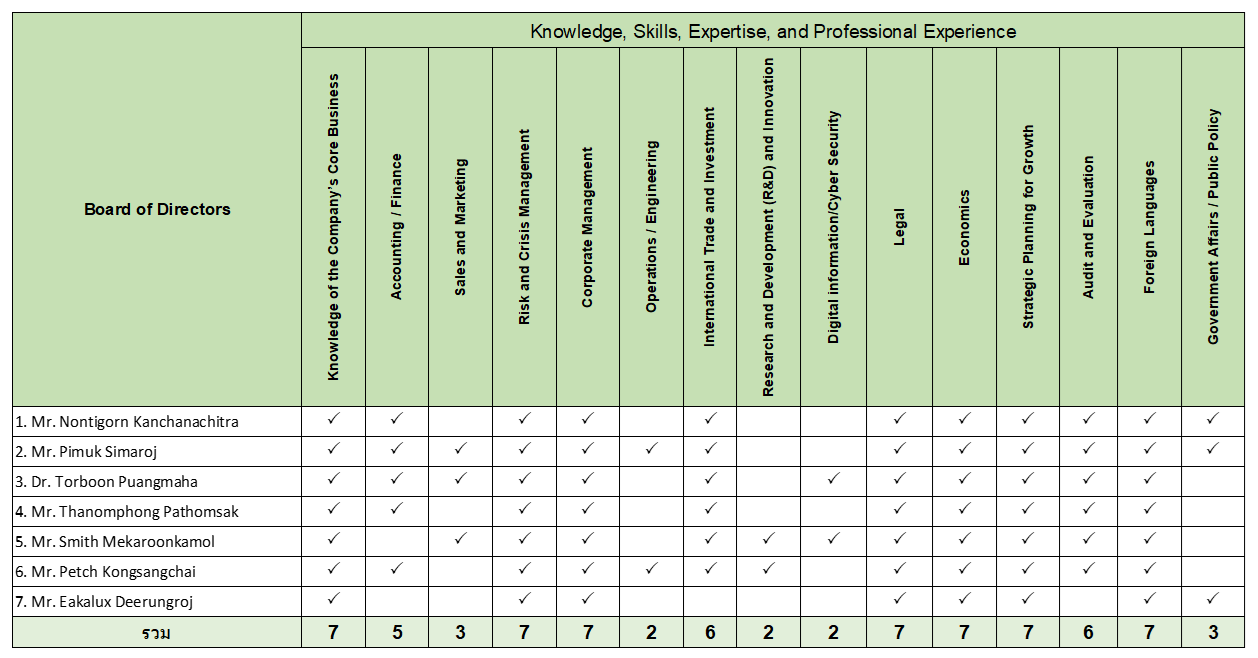
Qualifications for Director Selection
| Qualification | Skill & Expertise |
|---|---|
| Qualifications, Knowledge, or Experience | 112 · Description: Economics · 163 · Description: Leadership · 166 · Description: Audit · 265 · Description: Governance/ Compliance · 1683 · Description: Business Administration |
Evaluation of Board & Subcommittee Performance
Criteria for Evaluating Board Performance
Annual performance evaluations should be conducted for the Board of Directors, sub-committees, and individual directors, with the evaluation results used to enhance the efficiency of their duties.
The Board of Directors and sub-committees should evaluate their performance annually to allow the Board of Directors to collectively consider performance and issues for further improvement and correction. Criteria should be established for comparing performance in a systematic manner.
Performance evaluation should be conducted for both committees and individuals. At a minimum, self-evaluation methods should be used, and the criteria, procedures, and overall evaluation results should be disclosed in the annual report (Form 56-1 One Report). The evaluation may utilize the revised assessment forms from the Thai Institute of Directors Association (IOD) for listed companies.
The Board of Directors may engage external consultants to assist in establishing guidelines and suggesting issues for the evaluation of the Board's performance, and such engagement should be disclosed in the annual report (Form 56-1 One Report).
The evaluation results of the Board of Directors will be used to consider the appropriateness of the board's composition.
Evaluation of Board Performance in the Past Year
Board of Directors: Performance evaluation of the Board of Directors (overall)
Evaluation topics include: 1. Structure and qualifications of the Board 2. Roles, duties, and responsibilities of the Board
3. Board meetings 4. Dynamics in the performance of duties by the Board 5. Relationship with management 6. Director development
The evaluation results of the Board of Directors (overall) showed an average score of 97.02 percent.
Performance evaluation of the Board of Directors (individual)
Evaluation topics include: 1. Individual qualifications 2. Readiness to perform duties 3. Participation in meetings
4. Roles, duties, and responsibilities 5. Relationship with the Board and management
The evaluation results of the Board of Directors (individual) showed an average score of 98.61 percent.
Sub-committee: Performance evaluation of the Audit Committee (overall)
Evaluation topics include: 1. Structure and qualifications of the Audit Committee 2. Meetings of the Audit Committee
3. Roles, duties, and responsibilities of the Audit Committee 4. Reporting by the Audit Committee
The evaluation results of the Audit Committee (overall) showed an average score of 96.53 percent.
Performance evaluation of the Risk Management Committee (overall)
Evaluation topics include: 1. Structure and qualifications of the Risk Management Committee 2. Meetings of the Risk Management Committee 3. Roles, duties, and responsibilities of the Risk Management Committee 4. Reporting by the Risk Management Committee
The evaluation results of the Risk Management Committee (overall) showed an average score of 97.46 percent.
Subcommittees
Subcommittees
| Results of the Subcommittee's Duty Performance |
|---|
The Risk Management Committee has performed its duties as stipulated in the Risk Management Committee Charter, including the scope of authority delegated by the Board of Directors. For the year 2024, the Risk Management Committee held a total of 2 meetings, with all 4 directors attending every meeting. During these meetings, the Risk Management Committee jointly considered and screened the following important issues: (1) Consider approving the establishment of Risk Assessment Criteria and a Risk Management Manual in accordance with COSO ERM standards to create an operational framework for the organization's personnel to systematically and efficiently manage uncertainties that may arise for the organization. (2) Consider approving the appointment of a Risk Management Working Group to ensure efficient risk management operations. (3) Consider approving organizational risks. (4) Consider approving the risk management guidelines and plan for the year 2025. |
Meeting Attendance & Remuneration
Justification for Directors' Non-Attendance
The company director is unable to attend the Board of Directors meeting in 2025 due to prior engagements. The Company encourages all directors to attend Board meetings regularly and consistently to ensure full participation in the Board’s deliberations.
Types of Remuneration of the Board of Directors
Establishment of an Appropriate Remuneration Structure and Performance Evaluation for Personnel within the Organization
The Board of Directors has established a remuneration structure designed to incentivize the Chief Executive Officer, senior executives, and employees at all levels of the organization to perform their duties appropriately, in alignment with the Company’s objectives, key goals, and the long-term interests of the business.
(1.1) Consideration of the appropriate proportion between monthly remuneration, short-term performance-based compensation such as bonuses, and long-term performance incentives such as the Employee Stock Ownership Plan (ESOP).
(1.2) In determining remuneration policies, the Board of Directors takes into consideration compensation levels comparable to those within the same industry, together with the Company’s performance.
(1.3) Establishment of policies regarding performance evaluation criteria and communication of such criteria to all relevant personnel.
The Board of Directors, excluding executive directors, has a role in determining the remuneration and evaluating the performance of the Chief Executive Officer as follows:
(2.1) Approving the criteria for evaluating the Chief Executive Officer’s performance. The evaluation criteria must ensure satisfactory management performance in alignment with the Company’s objectives, strategies, and long-term business interests, and such criteria must be communicated to the Chief Executive Officer in advance.
(2.2) Conducting an evaluation of the Chief Executive Officer’s performance on an annual basis.
(2.3) Approving the annual remuneration of the Chief Executive Officer based on the performance evaluation results, together with other relevant factors.
The Board of Directors approves the criteria and factors for evaluating the performance and remuneration of the Chief Officers of various functions and assigns the Chief Executive Officer to conduct the evaluation of those Chief Officers in accordance with the established evaluation principles.
The Board of Directors shall oversee the establishment of performance evaluation criteria and factors applicable across the entire organization.
The Chief Executive Officer is responsible for considering and approving the remuneration structure for employees within the organization.
Remuneration or Benefits Payable to the Board
| Metric | Amount (Baht) |
|---|---|
| Remunerations or benefits pending payment to the board of directors over the past year (baht) | 0 |
Supervision of Subsidiaries & Associated Companies
Does the Company Have Subsidiaries or Associated Companies?
Yes
Is There a Mechanism for Overseeing Subsidiaries and Associated Companies?
Yes
Mechanism for Overseeing Management of Subsidiaries
1. Investment in Subsidiaries and Associated Companies
The Company has a policy to invest in subsidiaries or associated companies that support its business, as well as to invest in companies aligned with its goals, vision, and strategic growth plans, which will lead to increased performance or profits for the Company, or to invest in businesses that benefit the Company to enhance its competitive capabilities and enable it to achieve its goal of becoming a leading operator in its core business. Subsidiaries and/or associated companies may consider additional investments in other businesses if such businesses have growth potential, can extend existing business lines, or are beneficial to the group's business, thereby generating good returns on investment. The Company will establish governance mechanisms to enable it to control, manage, and be responsible for the operations of its subsidiaries as if they were integral units of the Company. This includes measures to monitor management and establish appropriate and sufficiently stringent internal control systems for subsidiaries to safeguard the Company's investment interests in accordance with established criteria, which the Company believes will create mutual benefits, increase revenue channels, and enhance the Company's profitability. The investment proportion will be considered appropriate to the potential risks and the Company's financial position, with proper investment analysis conducted before deciding on various projects. Such investment decisions must be considered and approved by the Board of Directors' meeting or the shareholders' meeting (as the case may be) and must comply with relevant notifications of the Capital Market Supervisory Board and the Stock Exchange of Thailand. Furthermore, the Company will appoint its qualified and experienced representatives to serve on the board of directors of such companies, at least in proportion to its shareholding, to set important policies and supervise the operations of the said subsidiaries and associated companies.
2. Policy on Supervision of Operations in Subsidiaries and Associated Companies
The Company has established a corporate governance policy for its subsidiaries and associated companies with the objective of defining both direct and indirect measures and mechanisms to enable the Company to effectively supervise and manage the operations of its subsidiaries and associated companies. The Board of Directors is responsible for overseeing the management and operations of the subsidiaries and associated companies to ensure alignment with the Company's goals, business growth direction, and strategic plans, as well as compliance with public company laws, civil and commercial codes, securities laws, and other relevant laws, including notifications, regulations, and criteria issued by the Capital Market Supervisory Board, the Securities and Exchange Commission (SEC), and the Stock Exchange of Thailand. The details are as follows:
(1) The Company shall consider appointing individuals as its representatives to serve as directors, executives, or controlling persons in its subsidiaries and associated companies, in proportion to its shareholding in each company. Their duty will be to supervise the subsidiaries and associated companies to ensure compliance with laws, good corporate governance policies, and other policies of the Company. However, the appointment of the Company's representatives as directors in each subsidiary and associated company must be considered and approved by the Board of Directors' meeting, taking into account the suitability of each company.
(2) If any transaction or operation of a subsidiary falls under the acquisition or disposition of assets as per the relevant notification on the acquisition or disposition of assets, or a connected transaction as per the relevant notification on connected transactions, which requires the Company to seek approval from the Company's Board of Directors' meeting and/or the Company's shareholders' meeting and/or relevant legal authorities before entering into such transaction, the subsidiary may only enter into such transaction or operation after receiving approval from the Company's Board of Directors' meeting and/or the Company's shareholders' meeting and/or relevant authorities (as the case may be). Furthermore, connected transactions between the Company and its subsidiaries and associated companies must be based on business reasons and conducted at market prices with clear and justifiable principles. The Company must also ensure that such transactions are disclosed in the financial statements every time, in accordance with the auditing standards for listed companies. The Company shall disclose information of both related parties to prevent potential conflicts of interest. Moreover, in cases where subsidiaries and associated companies enter into transactions, or when certain events occur in subsidiaries and associated companies that require the Company to disclose information to the Stock Exchange of Thailand according to the criteria set by the SET Board, the representative directors of such subsidiaries and associated companies are obliged to immediately notify the Company's management upon learning of the plan to enter into the transaction or the occurrence of the event.
(3) The directors and executives of subsidiaries and associated companies have a duty and responsibility to disclose information regarding their financial position and operating results to the Company. It is stipulated that relevant notifications of the Capital Market Supervisory Board and the Stock Exchange of Thailand Board shall be applied mutatis mutandis. They must also disclose and submit information on their interests and those of related persons, or transactions that may give rise to conflicts of interest, to the Company's Board of Directors and avoid entering into transactions that could create such conflicts of interest.
(4) The Company shall establish necessary plans and operations to ensure that its subsidiaries and associated companies disclose information regarding their operating results and financial position to the Company. The Company shall undertake necessary actions and monitor that its subsidiaries and associated companies have adequate and appropriate disclosure systems and internal control systems for their business operations. Furthermore, the Company shall closely monitor the performance operations and performance of the said subsidiaries and associated companies and present analysis results, including opinions or recommendations, to the Company's Board of Directors and the board of directors of the respective subsidiaries or associated companies. This is to be used for consideration in setting policies or improving and promoting the continuous development and growth of the businesses of the subsidiaries and associated companies.
Oversight Mechanisms
| Mechanism |
|---|
| Sending representatives to act as directors, executives or controlling persons in proportion to shareholdings |
| Defining the scope of powers, duties and responsibilities of directors and executives who represent the company in setting important policies |
| Disclosure of financial information and operating results |
| Transactions between the Company and related persons |
| Acquisition or disposal of assets |
| Internal control system of the subsidiary operating the core business is appropriate and sufficient in the subsidiary operating the core business |
| Other important transactions |
Agreements Between the Company and Shareholders in Managing Subsidiaries
The Board of Directors is responsible for ensuring that there are frameworks and mechanisms for overseeing the policies and operations of subsidiaries and other entities in which the company invests, to ensure understanding and correctness at a level appropriate for each entity, and that subsidiaries and other entities in which the company invests also have a correct and consistent understanding.
The Board of Directors appoints individuals to serve as directors, executives, or persons with controlling power in subsidiaries and associates, proportionate to the shareholding in each company, to oversee and ensure that the subsidiaries and associates operate in compliance with laws, good corporate governance policies, and other policies of the company. However, the appointment of company representatives as directors in each subsidiary and associate must be considered and approved by the Board of Directors' meeting, taking into account the suitability of each company, and documented in writing.
Define the scope of authority, duties, and responsibilities of individuals representing the company as per (1), and ensure that the company's representatives oversee compliance with the policies of the subsidiary. In cases where the subsidiary has other co-investors, the Board should establish a policy for representatives to act in the best interest of the subsidiary and in alignment with the company's policies.
The internal control systems of subsidiaries are appropriate and sufficiently stringent, and that various transactions are conducted correctly in accordance with relevant laws and regulations.
Establish necessary plans and operations to ensure that subsidiaries and associates fully and accurately disclose information regarding financial position and operating results, related party transactions, acquisition or disposal of assets, other significant transactions, capital increases, capital reductions, dissolution of subsidiaries, etc. And monitor and oversee that directors and executives of subsidiaries comply with their duties and responsibilities as stipulated by laws and contractual obligations, including relevant regulations of the Securities and Exchange Commission and announcements of the Stock Exchange of Thailand, applied mutatis mutandis, as well as disclose and submit information on their own interests and those of related persons, or transactions that may give rise to conflicts of interest, to the Board of Directors for acknowledgement, and avoid transactions that may create such conflicts of interest.
If it involves significant investment in other entities, such as having voting rights of 20% but not exceeding 50%, and the investment amount or potential additional investment is significant to the company, in necessary cases, the Board of Directors has a policy to prepare a Shareholders’ Agreement or other agreements to clarify management authority, participation in important decision-making, and performance monitoring, so that the information can be used for preparing the company's financial statements in accordance with standards and timelines.
Board Duty Performance — Overview
Board Duty Performance — Overall Description
Performance of the Board of Directors During the Past Year
During the past year, the Board of Directors has performed its duties with responsibility, prudence, and integrity, in compliance with applicable laws, the Company’s objectives, Articles of Association, resolutions of the shareholders’ meeting, and the principles of good corporate governance. These have served as the framework for overseeing the Company’s business operations with the aim of creating sustainable growth and long-term value for shareholders and all stakeholders. The Board has determined the Company’s direction, strategies, and business plans in alignment with economic conditions and trends in the spa and wellness industry, with a focus on enhancing service standards, developing products and services, improving operational efficiency, and maximizing the effective use of resources.
In the past year, the Board of Directors held a total of six meetings. The Board closely monitored the performance of the management team and carefully considered key matters relating to the Company’s business operations. These included the nomination and appointment of directors to sub-committees to ensure an appropriate governance structure; the consideration and approval of the annual budget and business plan for 2026; the approval of improvements to the organizational structure (Organization Chart) to support the Company’s growth plans; the approval of executive-level benefits to align with roles, responsibilities, and the Company’s competitiveness; and the determination of remuneration for the Board of Directors and the Chief Executive Officer in line with their duties, responsibilities, and the Company’s performance.
The Board also considered and approved the review of corporate policies, charters, and scopes of authority to ensure alignment with good corporate governance principles and relevant regulations. In addition, the Board reviewed the Company’s vision, mission, and corporate strategies to ensure consistency with business directions and changing circumstances. The Board approved revisions to the Delegation of Authority to enhance management efficiency under an appropriate internal control framework, provided opinions on connected transactions by considering reasonableness, transparency, and the best interests of the Company, reviewed and monitored the adequacy of the internal control system, and established corporate risk management strategies and frameworks to support long-term business operations.
Furthermore, the Board of Directors oversaw the system for receiving complaints and suggestions from stakeholders. During the past year, no significant complaints were reported, and the Board regularly acknowledged reports on the performance of sub-committees to ensure effective oversight in each area.
With regard to the Nomination and Remuneration Committee, the Company is currently in the process of considering its establishment and expects to complete the process within 2026. The establishment of this committee aims to enhance the efficiency of director and executive recruitment, remuneration determination, and governance of human resources at the Board and executive levels in accordance with good governance principles.
Throughout the year, the Board of Directors has performed its duties to the best of its ability and has continuously provided strategic guidance to the management team in order to strengthen the organization and support Onsen Retreat and Spa Group Public Company Limited in conducting its business with stability, transparency, and sustainable long-term growth.
Audit Committee Duty Performance
Results of the Audit Committee's Duty Performance in the Past Year
The Audit Committee of Onsen Retreat and Spa Group Public Company Limited consists of 3 independent directors who are qualified, independent, knowledgeable, and experienced, which supports the Audit Committee in performing its duties effectively and independently. Mr. Pimook Simaroj serves as the Chairman of the Audit Committee, and Dr. Torboon Puangmaha and Mr. Thanompong Pathomsak serve as Audit Committee members. The Audit Committee has performed its duties in accordance with the responsibilities assigned by the Board of Directors and the established Audit Committee Charter.
In 2025, the Audit Committee held a total of 4 meetings. Mr. Pimook Simaroj, Dr. Torboon Puangmaha, and Mr. Thanompong Pathomsak attended all meetings. The Audit Committee invited management, the auditor, and independent internal auditors to attend meetings as appropriate. The key aspects of the Audit Committee's performance of duties are summarized as follows:
1. Review of Financial Statements
The Audit Committee reviewed the financial statements and annual financial reports for 2025 to ensure that financial reports are accurately prepared and adequately disclosed. The Audit Committee held meetings with the auditor and executives responsible for the accounting and finance department and found that the preparation of financial statements complies with legal requirements and accounting standards and financial reporting standards, is reliable and timely, and includes sufficient disclosure of information.
2. Review of Internal Control System
The Audit Committee has prioritized the internal control system in accordance with the guidelines set by the SEC, which covers organizational internal control, risk management, operational control, information and communication systems, as well as monitoring systems. The Audit Committee considered and approved the internal audit plan for 2025, including reviewing the results of the internal control assessment and recommendations for improvement prepared by P&L Internal Audit Co., Ltd., an external internal audit service provider, to evaluate the overall internal control of current key processes, as well as monitoring internal control improvements and preparing for the SEC's internal control sufficiency assessment questionnaire, and providing recommendations for improving internal controls to align with best practices. The Audit Committee believes that the Company has appropriate and sufficient internal control systems to effectively and efficiently manage operations in accordance with its goals, objectives, and relevant laws.
3. Review of Related Party Transactions or Transactions with Potential Conflicts of Interest
The Audit Committee reviewed and provided opinions on related party transactions between the Company and its subsidiaries with potentially conflicting parties for the year 2025. The Audit Committee is of the opinion that the Company's related party transactions are conducted at rates generally applied to third parties and involve price comparisons for buying/selling with other buyers or sellers, thus constituting transactions under general commercial terms. These are normal business transactions and transactions supporting normal business operations. The Audit Committee believes that the disclosure of the Company's related party transactions is accurate, complete, and sufficient.
4. Consideration of Appointment of Auditor and Annual Audit Fees
The Audit Committee considered the independence, knowledge, competence, business understanding, quality of work, and appropriateness of audit fees, and approved EY Office Co., Ltd. as the auditor for 2025.
5. Consideration of Appointment of Internal Auditor and Service Fees
The Audit Committee considered the independence, knowledge, competence, business understanding, quality of work, and appropriateness of service fees, and approved P&L Internal Audit Co., Ltd. as the internal auditor for 2025.
In summary, the Audit Committee has overseen the Company's operations within the scope, authority, duties, and responsibilities assigned, exercising knowledge and competence with due care and prudence, and maintaining independence in performing its duties, having received excellent information and cooperation from the Company's management. The Audit Committee is of the opinion that the Company's financial statements are accurate and adequately disclosed, in compliance with legal requirements and accounting standards and financial reporting standards. The Company has an adequate and effective internal control system, including internal control review and risk management. Related party transactions are appropriate and reasonable, and all relevant laws have been correctly and completely complied with, in accordance with good corporate governance principles.
Executive Committee Duty Performance
Results of the Executive Committee's Duty Performance in the Past Year
The Executive Committee has strictly performed its duties in accordance with the Executive Committee Charter, as well as the scope of authority assigned by the Board of Directors. In 2025, a total of 10 Executive Committee meetings were held, with 3 directors attending every meeting.
Note : Mr. Kyoichi Takeda concluded his duties at the Company effective July 1, 2025. The Board of Directors' Meeting No. 3/2025, held on August 14, 2025, resolved to appoint Mr. Seiichiro Tamura, effective September 1, 2025, reflecting cooperation and continuity in overseeing and monitoring the management's operations. In each meeting, the Executive Committee jointly considered, screened, and provided opinions on various important issues related to the Company's business operations, with key points summarized as follows:
(1) Define the vision, mission, and business objectives.
(2) Consider approving the annual business plan and budget.
(3) Consider approving various policies of the Company.
(4) Consider approving long-term investment in land and building leases.
(5) Consider approving investment in business expansion in the form of spa services.
(6) Consider acknowledging and monitoring the progress of operations and management of various departments, as well as providing recommendations for management to achieve the established business plan and goals.